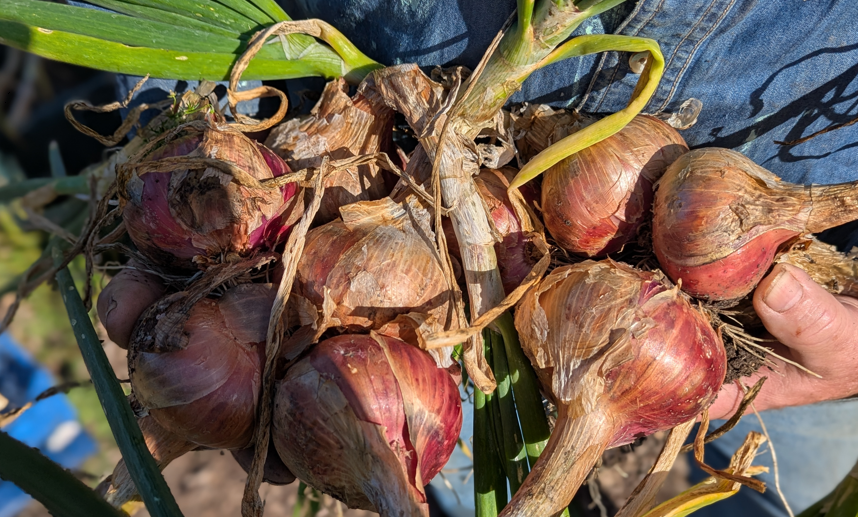
It is my understanding that onions, as we know them today, are a fairly recent phenomenon. If my information is correct, domestic onions were not originally the single bulb plants we see nowadays. The single bulb onion seems to be a fairly recent "innovation" designed to make them larger and easier to harvest by mechanical means. Historically, onions were smaller multi-bulbed plants a bit like garlic but with each bulb being a distinct entity joined at the base rather than in a clove. The idea was that you did not need to grow the onion from seed. At harvest time you just broke off a bulb from the main bunch, planted it back, and then took the remainder away to be eaten. Hence the name "Potato Onion". This is a much simpler process if you are doing things by hand but not if you are harvesting mechanically.
As was typical back then, each region apparently had their own locally adapted Potato Onions but the development of the larger single bulb types, and the ready availability of seed from them, drove most of the Potato Onion cultivars into extinction. A very small number of the varieties hung on in some places (particularly North America) and you can still get them - but they are not common. Phyto-sanitary regulations prevented me from importing the bulbs themselves (I am in the UK) but I did manage to find and order some seeds. The resulting onions were quite small and did not split nearly as well as the sales pitches would have you believe. They also did not do well in my garden. This was probably not the seeds fault as they were not adapted to my local climate.
The Goal
Once I had heard about the concept, I was determined to have some locally adapted Potato Onions. Given the disappointing results of my initial attempt to obtain worthwhile Potato Onions from seed, it seemed that the only reasonable way forward would be to breed my own. So, I resolved to try and breed a proper locally adapted Potato Onion.
The ultimate goal is to have a Potato Onion bulb that can be planted in the spring, or even the previous late autumn, which would then split and produce a clump of equal sized bulbs by the end of the growing season. Each of the bulbs should be able to be planted out again in subsequent growing seasons. The planting and splitting should be able to continue indefinitely.
There are other critera as well. The onion should be of a reasonable size, should store well, have an agreeable taste and, very importantly, it must be able to set viable seed. This last requirement is an absolute must have. If, on the Breeding Methodology page, you read about the problems this project encountered getting viable breeding stock you will soon realize why not setting seed gets an onion immediately culled - no matter how good it's other characteristics may be.
An additional aspect of the project goal is that, if there is any interest, any varieties produced will be released into the public domain as open source.
The yearly results are reported at the bottom of this page. Although the project has been running for quite a few years, the year of 2023 was the first time the output of the project was felt to be sufficiently interesting to be worth reporting.
Ultimately, the Potato Onion Resurrection project is intended to develop useful Potato Onions which can then be propagated vegetatively. The year 2026 saw things progress to the point that "Named Lines" could begin to be selected and released. A list of all named Potato Onions can be found at the link below:
If you are interested in obtaining bulbs or seed from the project, please see the following page for more information: Obtaining Potato Onion Seed.
Results
A YouTube Channel has been created to provide video documentation of the various project results. A list of the available videos is below:
As mentioned previously, a report for each project year (starting in 2023) has been produced. You can find the list below. It should be noted that these reports are not just dry "numbers and pictures" documentation. Along with a discussion of future intentions and directions, there are a sometimes side experiments which happen during the course of the project year and these are also documented.