OK, so you have obtained some seed from the Potato Onion Resurrection project. You can use it to create your own Potato Onions probably equal to or better than any of the named lines produced by the project to-date.
Here is what you need to do:
Super Short Summary
- Plant the seed out in the spring.
- Harvest the bulbs in the autumn.
- Plant the bulbs out again in the second year
- From the ones that split choose your own distinct Potato Onion lines.
Slightly Longer Summary
- Plant the seed out in the spring as you would any normal biennial onion.
- Be aware that the seed is bred to be extremely diverse. Some of the resulting bulbs will be quite large and there is a distribution of smaller sizes below that. Some will never get larger than salad onions and some just do nothing. Do not expect them to be consistent.
- No Potato Onion has ever been observed to split in the first year so you should not expect this. At the end of the first season you should have a collection of onion bulbs of various sizes, most will be white, some kind of pink and a few (very few) will be red.
- Store the bulbs over the winter and plant them out again in the spring.
- About 75% should split into clumps of at least two in the second year.
- Pretty much all of them will try to set seed. You can just cut off the scapes as they appear.
- As you harvest in the autumn of the second year, choose the clumps which you think look interesting and keep them separate.
- In the spring of the third year break up the interesting clumps and plant out the bulbs individually.
- There is no guarantee that bulbs which split in the second year will split again in the third year - nearly all do though.
- Congratulations. You now have your own genetically distinct lines of Potato Onion unique to you. Keep propagating them vegetatively to build up the numbers and share with others.
The Verbiage
You do not really need to read any further in order to obtain some Potato Onion bulbs from the seed you have - the summaries above are more than enough. However, I thought it might be useful to include a few paragraphs of backfill in order to add a bit of context and to provide some extra content for those that like that sort of thing.
So, you want some Potato Onions. I'm making assumptions here, but probably the preferential solution would be for somebody to just give you a small bag of their "known good" Potato Onion bulbs and you could then just get on with it.
The problem is, as you have probably found out, that interesting Potato Onion Lines are not all that common. There are more becoming available every year but they are still something of a niche product and there simply is not a lot of variety or quantity as yet.
The Potato Onion Resurrection Project has the same problem. It has produced a number of interesting named lines but it is early days and, although the bulbs split every year, it will be a decade before the numbers grow sufficiently large to be able to make bulbs from the named lines available even in modest quantities.
But you need them now - not in 10 years! How can the project get Potato Onions out to you?
Well, the project is not in a position to distribute bulbs, but it can possibly provide you with some of the seed. From this seed you can produce your own lines of Potato Onion in two years. The resulting Potato Onions will be genetically distinct, unique to you and some will probably be equal to or better than any of the named lines produced by the project so far.
Once you have grown your own bulbs from seed you can then vegetatively propagate them, build the numbers up and give them to others if you wish. All of the seed is offered as open source.
As for the propagation methodology - please realise that the summaries above just short cut the rather intricate breeding methodology and remove the steps designed to create and maintain a diverse set of genes in the seed stock. Since you have the seed, you can just have a go at generating worthwhile Potato Onions from it and jump straight to the results. Of course, if you wish, you can continue the breeding process as well.
So, let's talk a bit more about some of the issues glossed over in the summaries.
There is a lot of diversity in the Potato Onion seeds and this will be quite visible in the first year bulbs. This is deliberate, I have no interest in "true-ing" up the seed stock (quite the opposite actually) since any resulting onions of interest will split and can then be propagated vegetatively. I just chuck all kinds of genes at them - as long as they split they get to stay and cross in with the next generation. The upshot is: do not expect to see consistent onion bulbs in the first year - the diversity is a major part of the value. However, this also means you might have to do some culling. Of course, how and what you cull is up to you but it is suggested that a very light touch is probably best in the first year. Sometimes onion bulbs that look really unpromising suddenly start to work well in the second year.
There is no guarantee that any one onion bulb will split in the second year. Anecdotally, the project is seeing about a 75% split rate - the clumpy genes are really good now. Most split into bunches of 2, but there are some 3's and some 4's. Some just stay as a single bulb onion. This is the point at which you start to cull with a firmer hand. At minimum, all bulbs that did not split should be removed. The project also strictly removes any onions which do not attempt to set seed. This, however, is due to a requirement to maintain a seed stock. If you are not intending to save the seed and breed from the onions then it is not necessary to have such a hard rule.
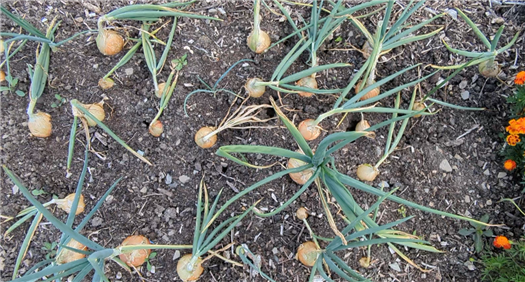
No Potato Onion has ever been observed to split in the first year so do not expect see it. They will only ever form single bulbs. You will need to store the bulbs over the winter and then plant them out in the following spring. After a month or two in their second season you should be able to see which bulbs are going to split and which will not. For example, in the image at left (click to enlarge) you can clearly see this onion is clearly going to split into four bulbs. This picture is from early May 2026 and the onion was grown from 2024 seed, brought on as a single bulb in 2025, kept over the winter and then planted out in April 2026. As stated repeatedly, obtaining Potato Onion bulbs from seed is a multi-year process. The resulting four onions will be identical clones but different genetically than those originating from any other seed. Thus, when your onions split in the second summer, you will have the beginnings of lines of Potato Onions unique to you. Just save the bulbs, store them over the winter, plant them again and (hopefully) they will continue to split (see below).
There is also no guarantee that the onions that split in the second year will continue to split in subsequent years as the bulbs are replanted. The project does not keep definitive data, but it looks like about 75% of the bulbs that actually split in the second year will continue to reliably split in future years.
The onions are also bred for longkeeping when stored in an unheated outdoor shed. A few will go off as they are stored over the winter and should be culled. The shallot-y looking onions are notorious for this so keep a particularly close eye on those ones. The bulbs handle the cold well though. In the autumn of 2025 an experiment was conducted in which a bulb was broken off from each clump and immediately replanted in an open bed and left out over the winter to endure snow, hard frosts and much rain. There was no protection of any sort and all of the onions cheerfully made it through the winter and began to grow and split. It should be noted that the extra growth time the autumn planting provided did not seem to produce noticeably better or bigger bulbs when compared to the onions stored and then re-planted in the spring. More experiments of this sort are needed.
Unless you wish to breed from the onions, you can cut off any scapes that appear. Cutting off the scapes does not seem to be necessary in order to make the bulbs split - indeed the ones that are going to split are clearly doing that well before any scapes appear. Also, most of the bulbs will not go mushy if you let them set seed or split - they appear to remain edible. In other words, if you plant out a bulb and it splits into two you typically get two identical bulbs - not two child bulbs and a bag of mush in the center. Mostly it happens this way - it seems many of the bulbs are are now quite perennial.
Good Luck with your onions. If you do produce some of your own Potato Onion Lines you can, if you wish, name them and have a photo, description (and possibly link) listed on the named lines page. Just get in contact via the address on the About Page for more information.